
WELCOME TO RAJA VENTURES
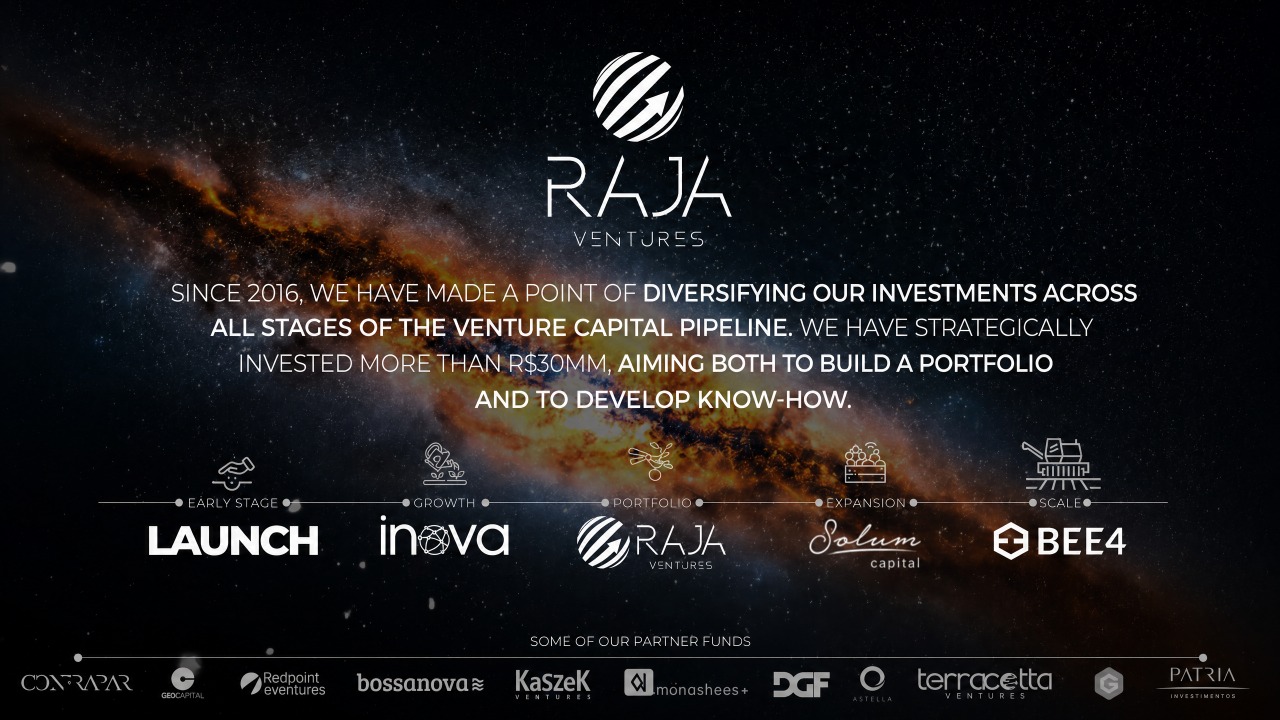

WE HAVE A DIVERSIFIED PORTFOLIO
WE BELIEVE THAT INVESTING IN INNOVATION IS THE PATH TO TRANSFORMING
NOT ONLY THE CORPORATE MARKET, BUT SOCIETY AS A WHOLE.






INVESTE RAJA IS AN EVENT THAT AIMS TO PREPARE BUSINESS OWNERS AND EXECUTIVES FROM A WIDE RANGE OF SECTORS TO BECOME POTENTIAL INVESTORS IN STARTUPS (INNOVATIVE AND TECHNOLOGY-DRIVEN) AND SCALABLE BUSINESSES

LAUNCH IS RAJA'S STARTUP PRE-ACCELERATION PROGRAM. IT IS MADE UP OF TECHNICAL CONTENT, TALKS AND WORKSHOPS THAT COMBINE THEORY AND PRACTICE AND TAKE PARTICIPANTS ON A JOURNEY THROUGH THE MOST RELEVANT TOPICS IN ENTREPRENEURIAL EDUCATION AND STARTUP DEVELOPMENT.
The latest edition of Launch took place in a hybrid format, with most sessions held online but some in-person stages at RAJA's headquarters in Belo Horizonte. Regardless of the session format, at least one member of the startup must attend every meeting.
Since good projects are not limited by ZIP code, we believe the hybrid format gives the best businesses greater reach and visibility. Even so, as the good mineiros (people from Minas Gerais) that we are, we never give up on spending time together and the power of exchanging ideas, preferably over a “cafézin” (a little cup of coffee).
We could write a beautiful, elaborate text here about market pain, business validation and so many other important disciplines that, like most accelerators on the market, we will certainly evaluate! However, here at RAJA we insist on “walking the talk”, that is, doing what we say, and that is why we practice what is known as “skin in the game”, which simply means getting into the game and contributing meaningfully to the businesses.
We believe that, for this to happen, it is essential that we know the sectors in which the new businesses operate so that we can contribute as much as possible! That is why we favor segments we know and work in, such as Industry, Civil Construction, Real Estate, Finance, Energy and Gaming. However, as the entrepreneurs we are, we never let good opportunities pass us by!
Once this premise is met, our main focus becomes just one thing: the Entrepreneur and the project team. In our view, a good idea has no value if there is no one capable of executing it! That is why we believe the profile of the entrepreneur and the project team are the decisive factors for success, and we look far beyond qualifications and skills to understand their profile, vision, strategy, passion, adaptability, hunger and drive to make things happen! Once these assessments are complete, we follow our playbook of best practices and hand the relevant evaluations over to our team of experts!
It depends. In the latest edition of Launch, we offered entrepreneurs different participation options, each tied to a different equity percentage according to their financial contribution toward running the Program:
• Entrepreneurs who fully fund their participation in Launch, investing R$9,000.00, enjoy all the content and give up no equity in their businesses to RAJA.
• Entrepreneurs who choose to partially fund the Program, up to R$6,000.00, give 3% of their projects to RAJA.
• Entrepreneurs who choose to fund the Program up to R$3,000.00 give 6% of their projects to RAJA.
• Finally, entrepreneurs who take part in the Program free of charge, with no financial contribution, give 9% of their projects to RAJA.
Launch is a 12-week Program in which market specialists are assigned to support the development of the participating startups, and running it is already a first major investment by RAJA in the selected new businesses. The equity contribution is a proportional criterion that seeks balance and a return on this investment, marking the kickoff of the partnership or, better said, of the new business partnership!
Throughout the 12 weeks, in addition to receiving targeted content and mentoring, the entrepreneurs and businesses are also evaluated and ranked, producing a ranking that determines the winners of the Program. The winners receive a first investment in the form of a prize, which in the latest edition was:
• 1st place: R$60,000.00
• 2nd place: R$40,000.00
• 3rd place: R$20,000.00
Startups that earn this investment automatically agree to give up additional equity of 7.5%, 5% and 2.5% for first, second and third place, respectively. These percentages are cumulative with the participation option chosen and described above.
There are three ways for startup investors to earn a return:
• Acquisition: the sale of the invested company to a larger company;
• Dividend payments: the distribution of part of a company's profits to its shareholders;
• IPO: listing the company on a stock exchange.
The most likely scenario is the first one: a sale (acquisition). If the startup manages to grow and win a significant market, it may become attractive to a larger company. When they negotiate a sale to that company, the partners usually make a substantial profit.
Many! For beginners, investing in startups can be speculative and very risky, because people tend to do it driven by emotion and superficially, without careful analysis.
Investing in startups should be seen as a journey, a search for exceptional opportunities, which tends to succeed when done with discipline and specialized advice, capable of digging deep into traction metrics, diving into numbers that confirm potential and analyses that consider the team, market, business model, performance metrics, growth potential, and customer acquisition and retention, among others.
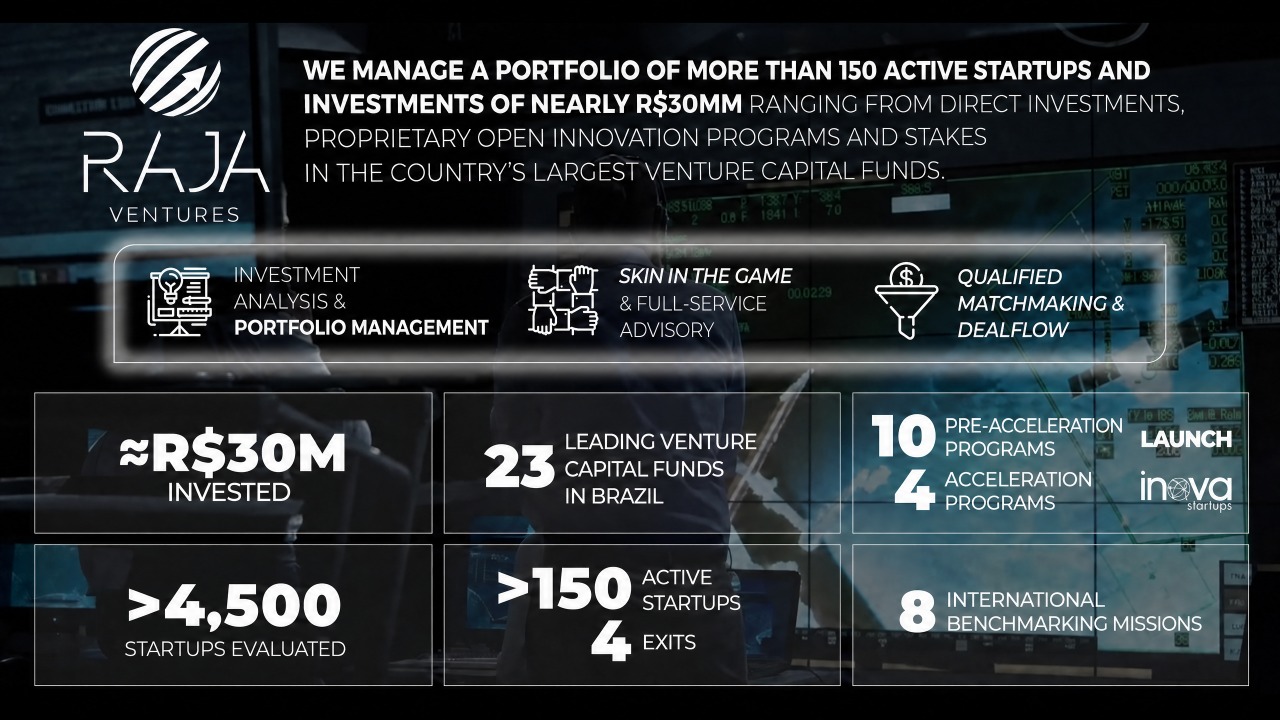
Over the last 8 years, RAJA has evaluated more than 4,000 startups, has invested in 200 and has extensive experience in identifying, measuring, evaluating (due diligence), analyzing and mitigating risks, including defining exit strategies.
There are different ways to invest in startups. Here are some of them:
• Mentoring or “Advising” (strategic advice): This is the “cheapest” way to invest in startups and can be an interesting option for those who have experience in certain sectors and want to actively contribute to the success of these companies. Startups often look for experienced, strategic people to help them move forward and overcome specific challenges along the way (such as structuring a sales team, marketing, building technology, creating internal processes, etc.). In exchange for this strategic help, the startup founders grant an equity stake (somewhere between 1% and 5%) as compensation. In this case, the return comes in the future, when the business grows in value and the advisor or mentor gains liquidity on that stake by selling it to a third party and putting the money in their pocket. This type of investment is also known as “Smart Money”.
• Crowdfunding and Investment Platforms: If you want to invest money in a startup, an easy way to do so is through crowdfunding or online investment platforms. These platforms allow investors to make small investments in startups in exchange for a stake in the business. The minimum investment on these platforms varies, but it is often accessible starting at R$1,000.00 (one thousand reais). To intermediate these investments, there is a company (usually the owner of the chosen platform) that handles the procedures with the startups, presents investors with all the business data so they can make the best decision and keeps them informed about the progress of the invested startup.
• Angel Investment: Angel investors are individuals who invest their own capital in early-stage startups. Angel investing is an opportunity to support promising companies at their earliest stage and receive an equity stake in return. Although there is no set minimum amount for this type of investment, angel investors commonly invest between R$50,000 and R$200,000 in a startup.
• Accelerators or Funds: Another way to invest in startups is through accelerators or specialized investment funds. These organizations select promising startups, invest in them and help them grow through strategic support and networks. In this case, the investor puts their capital into the fund or accelerator, which takes care of building a diversified portfolio of startups. Here the investment amount is practically the same as in Angel Investment, and the investor's involvement in the startup's day-to-day may even be similar, depending on the investment thesis of these institutions. However, it is an excellent way to share the risk, since the money will be invested in several startups, together with several investors. So, although an investment of, say, R$100,000 is made in the fund, that fund will pool around R$5 million in total from several investors to invest in several startups, diluting the risk.
It depends on its needs, and it is essential that the startup has a clear plan for where to allocate the funds, whether for team development, products, marketing, commercial expansion, etc.
Receiving investment is an important milestone in a startup's journey. This type of funding, usually coming from an experienced and successful investor, not only injects capital into the company but also opens up a range of opportunities and challenges. It therefore requires strategic planning and effective execution to ensure the continued success of the business. It is vital to stay focused on the company's vision and goals and avoid distractions. Being clear about how this investment can drive the sustainable growth of the business is also essential.
The investor's first and main responsibility is to put financial capital into the startup, aiming to accelerate its growth in the market and, naturally, to earn a return greater than the amount invested. It is worth noting that the investment can be made in money and in knowledge (smart money).
Since the investor wants to earn a return, it is a good idea for them to learn about the business, its products and strategies so they can help through business referrals and partnerships that can create value and leverage, within their limits. It is common and healthy for the investment agreement to address this discussion and set out other responsibilities, such as a seat on the Board of Directors. This is important to preserve boundaries and avoid friction with the company's executives.